1 LiveBloggin' the ICW

Tuesday, January 28, 2025

A Highly Seasoned Boater's Advice on Our Marina

Commentary: A Highly Seasoned Boater's Advice on Our Marina

Posted 

This article was posted in The Fernandina Observer, and expresses my thinking on much of what we're seeing on the US east coast today. 


By Wally Moran

Having stopped in Fernandina Beach by boat more than 50 times myself, and having led 10 boating rallies that have stopped here, I feel I need to comment on your marina fee issue.

Fernandina Beach is a gem along the Intracoastal Waterway for boaters making the seasonal transit north and south. Unlike many stops along the Eastern coast, Fernandina Beach is easily accessible from the water. With a vibrant, attractive downtown just steps away, it's a favorite stop in Florida for many -- myself included.

Your mayor commented at a recent city commission meeting about transient vessels being "millionaires' yachts." The fact is, the majority of boats traveling south aren't "millionaires' yachts," they are typically 35 - 45 foot vessels belonging to retirees, people living on a fixed income of pensions and their savings.

These boaters are not people who blithely throw $100 bills at the peasants, these are people who watch their expenses carefully. In today's economy, they are even more cautious. Painting them as "millionaires" does nothing more than mislead people on how to properly manage marina issues.

Then there are the thousands of people who come to town to go for a boat ride, or fishing, putting money in the pockets of local businesspeople. When all of these folks arrive in town, whether by boat or car, they explore, they spend money at restaurants, shops, boat supplies and more. They are a significant part of the health of your downtown business sector, and the marina is the door through which they come in.

Some of your elected representatives may see the marina as a money pit, a hole that sucks up taxpayer dollars. I wonder how many of them have the wisdom to see the marina as a facility that generates millions of dollars for the downtown merchants, that helps to ensure that your downtown remains the attractive and viable place that it is.

Without the marina, just how would your downtown fare? I think that question is rather easily answered, given the recent history following the hurricane that put the marina out of commission. The marina is a significant generator of traffic for your city.

Then there is Oasis, the marina management company. Your city commission needs to keep in mind the fact that Oasis' interests are in keeping the operation profitable for Oasis. They don't care about the financial well being of your downtown. That's not what they are there for. So when Oasis asks the city to increase prices, it's to benefit Oasis, not Fernandina Beach.

Unfortunately, the city marina has developed a reputation amongst boaters as an expensive stop. Here's a review from last March in marinas.com:

"Nice concrete docks. The slips aren’t secure, no key cards to enter dock area. The showers are filthy, full of mold. No paper towels to wipe your hands using the toilets. The lounge is only open until 1700. Shockingly expensive for services."

And for this level of "luxury," the average millionaire - er, boater, is paying $100/night or more, plus another $6 - $25 for power. You can stay at a local motel for less than that, with a pool and other amenities, clean showers and 24/7 staff.

I have observed this recent trend of city administrations on the East Coast handing over a valuable marina asset to management firms. In no location that I can think of have services improved. In truth, services have typically been reduced while costs to the boater increase. How could they not? The beast needs to be fed, and inserting another entity into the mix guarantees higher prices.

Boaters lounge? Shut it down at 5 p.m., despite the fact that most boaters arrive late in the day and leave early in the morning and so, won't be able to use it. Clean showers? If we have time. Gotta watch those profits.

The fuel issue. The city has lost 3/4 of a million dollars "due to myriad design and equipment flaws at its fuel dock." Well, who is the genius behind this fiasco, and has it been corrected? Because of its location and the distance to the next marina with fuel, Fernandina Beach is a mandatory fuel stop for many boats.

Fixing whatever the problem is here should be a priority, since those fuel profits could go a long way towards lowering those losses being complained about. Is there anyone taking charge of this? Hello?

The Fernandina Beach city marina had a well deserved reputation as a friendly, well managed and reasonably priced stop for many years. My advice to your city commission is to hire a results-oriented marina manager -- they're out there -- and dispense with feeding a profit-oriented company. Those profits can be used to the city's benefit.


Wally Moran's land base, though he is rarely there, is Orillia, Ontario. He says, "I actually travel pretty much full-time on my sailboat with my dog, Aduana, who I rescued from Cuba a number of years ago." He retired at 47 to go sailing. Before that, he was a newspaper editor and publisher. He writes for a variety of sailing publications and gives seminars at boating shows. And yes, Fernandina Beach is one of his favorite spots in Florida.

Wednesday, February 21, 2024

Miami Beach Boaters Are Being Screwed...And You are Next!


Where to start this post? I have never in my life seen what I'm seeing now in Miami Beach. Essentially, Miami Beach is out to screw anyone anchoring out in their waters. And, to their credit, they are doing it very efficiently.

Miami Beach has been anti-anchoring for as long as I can remember, and that memory takes us back to the early 00s. For some history on what's gone on in Miami Beach, see this blog post. These people have hated boaters anchoring out for many, many years.
Recently however, Miami Beach has managed to excel itself in its hatred of anchored out boaters. I know, hard to believe. Here's the scenario. 

Currently, there are ~137 boats anchored out within Miami Beach's jurisdiction, and that includes some 100 or so people living aboard. I took a run through the anchorage about a week ago - there are a couple of sketchy boats and a small houseboat the size of a large shed, but by and large, the boats run from decent to very good condition. There's a jet ski rental operation at anchor to avoid Miami Beach regulation - that is a problem. Otherwise, it's a fairly typical anchorage.

However, Miami Beach residents, including a number of "condo commandos" in the nearby towers, have complained about boats at anchor. The city council is listening to them and has decided to act. Here is how it's going down.

In 2022, MB applied for a mooring field. The usual process of setting up a mooring field typically takes 2 - 3 years from first proposals to opening day. MB's process is at the two year mark and the field won't be open until March 2026. 

Ok, so what's the problem here? The city refuses to complete the mooring field process unless it gets permission for an Anchoring Limitation Area (ALA) from Miami Dade County. It has made this decision part of its process for proceeding with the mooring field. No ALA, no mooring field. From what I've seen, the City expects this to be granted. What it means is that the city can then remove the anchor outs after 45 days after the ALA is granted and properly set up.

I just spoke with people at Miami Dade County who are involved with permitting any mooring field in the county. There is no chance that an ALA will be in place this year, and from the discussion, it's not very likely to happen in 2025 either. Therefore, based on the City's own resolution, there will be no mooring field.
City of Miami Beach officials were unaware of this fact. They advise me that they are continuing to work on the mooring field, as ordered by management, which of course is acting on the orders of the Commissioners. 

But - on top of this, the Florida legislature has a bill in front of it, SB 192 in the Senate, that if passed will disallow overnight anchoring within 200 yards of Miami Beach's shoreline. The problem there is that anything beyond that 200 yards is much too shallow to anchor in. The bill effectively outlaws anchoring in Miami Beach.

How does that work? If SB 192 is passed, there will be no boats anchored in Miami Beach. No boats, no need for a mooring field, right? 

If SB 192 is passed, it will be illegal to anchor overnight anywhere in Miami Beach after July 1, 2024.. If the bill is not passed, and the ALA is permitted by the County, then 45 days after the ALA is permitted, any boats anchored in Miami Beach will have to leave within 45 days, because the mooring field won't be open.

Basically, if you're living aboard or have your boat anchored out in Miami Beach, you're screwed. 
I grant you, this is very clever on the part of the Miami Beach city commissioners. They want the boaters gone, and this, if they get their way, will accomplish it.

But wait, you say. In 2025, the boaters can return to the mooring field. Or in the meantime, they can move to a marina.

Well, maybe. Actually, maybe not. The boaters who will have left will have re-established themselves elsewhere, or moved ashore. My bet is that the moorings will go to non-liveaboard boaters, locals who want a cheaper place to store their boat.

And if the current boaters move to a marina - oh, wait. There are no marina slips available. I phoned every marina in Miami and Miami beach last week. There weren't even ten transient slips available, much less any long term liveaboard slips.

All this is assuming that the mooring field actually is put in place. If that sounds cynical, there's this in the mooring field information:

The City will permit the entire mooring field area and build the anchors/mooring balls as needed, but the entire area will be under City control even if no anchors are installed. As a result, the marina patrol can enforce any unauthorized mooring.

Did you get that? If the city gets permits and then decides NOT to put up moorings, they can still police the area and ticket boats that anchor there. That's world class sneaky right there. And why would they choose not to install the mooring balls? Maybe because there's no need, as there are no boats anchored out, because of SB 192? Or am I just being overly cynical? 

Bottom line, there is no place for these boaters to go if they want to remain on the water, other than to move away from their jobs and their loved ones, or give up their boats and move ashore. And there's no place for you, as a transient boater, to anchor out anywhere in Miami Beach.

I mentioned that Miami Beach has been nasty - but I didn't get into that in detail. Let me do that now. 

City commissioner David Suarez, newly elected last fall and who, because of his behavior and attitude is already despised by many in the city's administration with whom I've spoken, appears to be the tip of this spear. He seems to have the backing of all the commissioners on this issue.

Shortly before Christmas, the city removed the sole dock available for boaters to go ashore, located at the Publix store on the Collins Canal. Local boaters used this dock to go ashore for food, run errands and to go to work. With details from the Miami Herald...

So Suarez and the commissioners removed the dock, tore it out about a week before Christmas, at night. They put up "NO TRESPASS" signs. And then Saurez went on TV and said gleefully that anchored out boaters would have to break the law to come ashore, and this would force them to move away.
"They can’t live on a boat forever," Suarez said during discussion of his proposal at the Dec. 13 commission meeting. "They have to come to the land to get food, water and necessary supplies...
  
..."we're cutting off basically their lifeline and then they’re going to have to be forced to do illegal trips to our sea wall." 

A WEEK BEFORE CHRISTMAS.  Scrooge has nothing on this prick.

Here's a link to the entire story.

Now for the record - Suarez is not a lily white crusader saving the citizens of Miami Beach from the evil anchor outs. He has been arrested for burglary. In 2022, following his divorce, the courts ordered his guns removed from his home for the protection of his children. From the Miami Herald:

Suarez was arrested in 2003 for burglary with tools and trespassing without authority as part of what he says was a “high school prank.” Prosecutors chose not to pursue the charges. During a divorce and custody proceeding in Broward County in 2020, a judge ordered Suarez to temporarily turn over a dozen guns and his concealed carry permit to police amid concerns they weren’t being stored safely around his young child.

And, he's currently being sued by a local developer for defamation. 

More recently, on January 25, he got into an argument with a local boater. The police intervened to keep the peace and the event was captured on police body cam video. In the video, Suarez' dog can be seen running around with no leash, in violation of the city's leash laws. You can see the video, with Suarez arguing with the police and trying to push the officer around, right here.

It seems that Suarez likes to make others follow the law while he ignores it. 

So what can we, as boaters, do to stop this? First of all, SB 192 needs to be stopped. If it isn't, other communities will demand the same sort of laws for their waters. If that happens, boaters will very shortly have no place left to anchor in Florida. Given that there is not nearly enough dockage for locals, much less transient boaters, that will create significant problems for all of us. 

We need all boaters and anyone else concerned about this overreaching legislation to contact the Senate Rules Committee by email and/or telephone and register their displeasure with this bill. If you're a Boat US member, you've already (or should have) received a link to do this. If not, the emails you need to contact the Rules committee are at the bottom of this article. 

A simple message stating that you are a boater and you object to Senate Bill 192 and want it removed from consideration will be adequate. Additional talking points will be on the Cruisers Rights Network FB page, details below.

Please be sure to do this. The senators need to know that we are watching and that we do not approve of SB 192. If you're a Florida resident, contact your Senator by phone AND email and make him/her aware of your views. Tell them you expect them to vote against SB 192, and don't forget to remind them, there's an election coming up soon. That seems to get their attention! Can't imagine why...

Secondly - join the Cruisers Rights Network of North America's Facebook page, at  Cruisers Rights Network. There will be regular updates on this issue there. 

Thirdly - we may need to fundraise for this effort. If we do, the appeal will go out on the FB page. Please be open to helping us fight to preserve your anchoring rights.

Lastly, and this is most important - spread the word to other boaters through your boating groups, your personal FB page and other social media. The more boaters who are aware of what is going on, the easier this will be to stop. There truly is power in numbers.

Constituency Talahassee Senator email

(321) 409-2025 (850) 487-5019 mayfield.debbie.web@flsenate.gov

(352) 264-4040 (352) 670-4212 perry.keith.web@flsenate.gov

(352) 750-3133 (850) 487-5013 baxley.dennis.web@flsenate.gov
(954) 424-6674 (850) 487-5035 book.lauren.web@flsenate.gov

(941) 742-6445 (850) 487-5020 boyd.jim.web@flsenate.gov

(407) 333-1802 (850) 487-5010 brodeur.jason.web@flsenate.gov

(850) 595-1036 (850) 487-5001 broxson.doug.web@flsenate.gov

(813) 779-7059 (850) 487-5023 burgess.danny.web@flsenate.gov

(863) 413-1529 (850) 487-5012 burton.colleen.web@flsenate.gov

(727) 563-1910 (850) 487-5018 diceglie.nick.web@flsenate.gov

(305) 442-6841 (850) 487-5036 garcia.ileana.web@flsenate.gov

(727) 771-2102 (850) 487-5021 hooper.ed.web@flsenate.gov

(386) 446-7610 (850) 487-5007 Hutson.travis.web@flsenate.gov

(305) 493-6002 (850) 487-5034 jones.shevrin.web@flsenate.gov

(954) 321-2705 (850) 487-5032 osgood.rosalind.web@flsenate.gov

(305) 470-2552 (850) 487-5040 rodriguez.anamaria.web@flsenate.gov

(727) 822-6828 (727) 822-6828 rouson.darryl.web@flsenate.gov

(850) 487-5003 simon.corey.web@flsenate.gov

(407) 846-5187 (850) 487-5025 torres.victor.web@flsenate.gov

(904) 723-2035 (850) 487-5004 yarborough.clay.web@flsenate.gov


emails only: You can copy and past this list into your browser to save having to send multiple emails


        mayfield.debbie.web@flsenate.gov

perry.keith.web@flsenate.gov

baxley.dennis.web@flsenate.gov
book.lauren.web@flsenate.gov

boyd.jim.web@flsenate.gov

brodeur.jason.web@flsenate.gov

broxson.doug.web@flsenate.gov

burgess.danny.web@flsenate.gov

burton.colleen.web@flsenate.gov

diceglie.nick.web@flsenate.gov

garcia.ileana.web@flsenate.gov

hooper.ed.web@flsenate.gov

Hutson.travis.web@flsenate.gov

jones.shevrin.web@flsenate.gov

osgood.rosalind.web@flsenate.gov

rodriguez.anamaria.web@flsenate.gov

rouson.darryl.web@flsenate.gov

simon.corey.web@flsenate.gov

torres.victor.web@flsenate.gov


Wednesday, November 22, 2023

March of the 423 Zombies


 Zombies - you've seen them in the movies, mindlessly marching on, implacable, unthinking, terrifying, intent on their destination with no thought of what's around them.
The Undead. Much like many of the new boaters heading south on the ICW in fact - unthinking and intent on getting south with no thought of what's around them.


It's said that one of the best reasons for learning to sail is that at the end of the world, you're safe on a sailboat, because zombies cannot swim. I don't know the truth of that, but I do know this - zombies can sail. I've observed them many times on the Intracoastal Waterway, following their predetermined path with no thought, no eyes, for anything but that blue line on the screen they are staring at.
I saw two of them today in fact, motoring one after the other down the ICW in southern Georgia. There they were, at least 75 yards out of the charted channel, following the path that the 423 Zombies are mandated to follow, no matter where it leads, Aids to Navigation be damned!
I am speaking of course of those boaters who have joined the Cult of Sherer, the AquaMaps people,  the 423 Zombies, who believe that their leader, Bob Sherer, can do no wrong.
Now in this case, it might also just be that these followers, these sailors, being Canadian, were reaching out desperately for whatever assistance they could find on their trek south to the sun that long ago deserted the Great White North.
Let's face it, it's a long way from the Great Lakes to south Florida.

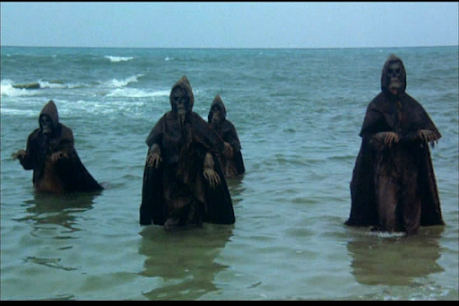
The photo shown here is purported to be their demonic leader, but since I have never met the man, I cannot personally attest to that. However, considering the stranglehold he has on their navigational sensibilities, it would take someone this starkly evil and demonic.
I'm told that in a past life, their leader was a corporate executive, so I suppose this picture could easily be one from before he became the leader of the 423 Zombies. Living life as a corporate executive has been known to do strange things to people. Ask any wokester!

By now, most of you have figured out that I'm trolling the sailors who travel the ICW using what have become known as Bob Tracks, a creation of GPX routes by Waterway Guide cruising editor Robert Sherer. 
Essentially, what Bob has done is take a recording of his route along the ICW and transferred it online, making it available for download to his social media group. Once these folks have downloaded the tracks, they can transfer them to their AquaMaps app on their phone or tablet. They then simply follow the charted route. 
Like zombies, never wavering from it.
Now don't get me wrong. For someone entirely new to the ICW, this has some advantages. They don't have to bother learning how to navigate for one thing. I mean, really, who needs to deal with issues of set and drift, plotting, getting a fix, or how to use dividers or understand what all those tiny letters on a chart actually mean? 
It's SO much easier to just follow the blue line laid out in front of you on your tablet.
For those of us with a lot of experience on the ICW - I'm now somewhere around 50 transits - this can be entertaining as you watch a line of boaters follow a path that sometimes takes the long way around, or that avoids an "obstruction", or shoaling, that isn't really an issue.
The other day, I watched one boater directly in front of me go well outside of the channel at the Carolina Inlet to avoid what he was told was a shoal there. I continued on straight, knowing that the "shoal" was at least 8 feet deep at MLW and there was no need to change course.
Here's the chart for this area, with Bob's Tracks in blue. 
As you can see, staying in the middle of the channel will keep you in a minimum of over 8 feet of water at MLW. At high tide, that will be over 12 feet of water, the tidal range here being 4 feet. There is no need to wander outside of the channel, and you would know this if you simply looked at the chart.
Is anyone hurt by diverting as this boater did? No, and if you feel better or safer by mindlessly following someone else's track in this way, go for it.
But as sure as God made puppies, there will come a day when two boaters going in opposite directions are going to meet at that diversion and someone is going to have to do some actual thinking about how and where to navigate their boat to avoid a collision or going aground. 
And this isn't a joke. The outline to using the Bob Tracks discusses this exact scenario, advising boaters that they must pass port to port, that the regulations REQUIRE them to do so. The problem is, if you're so clueless about navigation that you have to use someone else's tracks to get where you're going, you're very unlikely to know the rules of the road.
So if that's all there is, why am I bitching about this? 
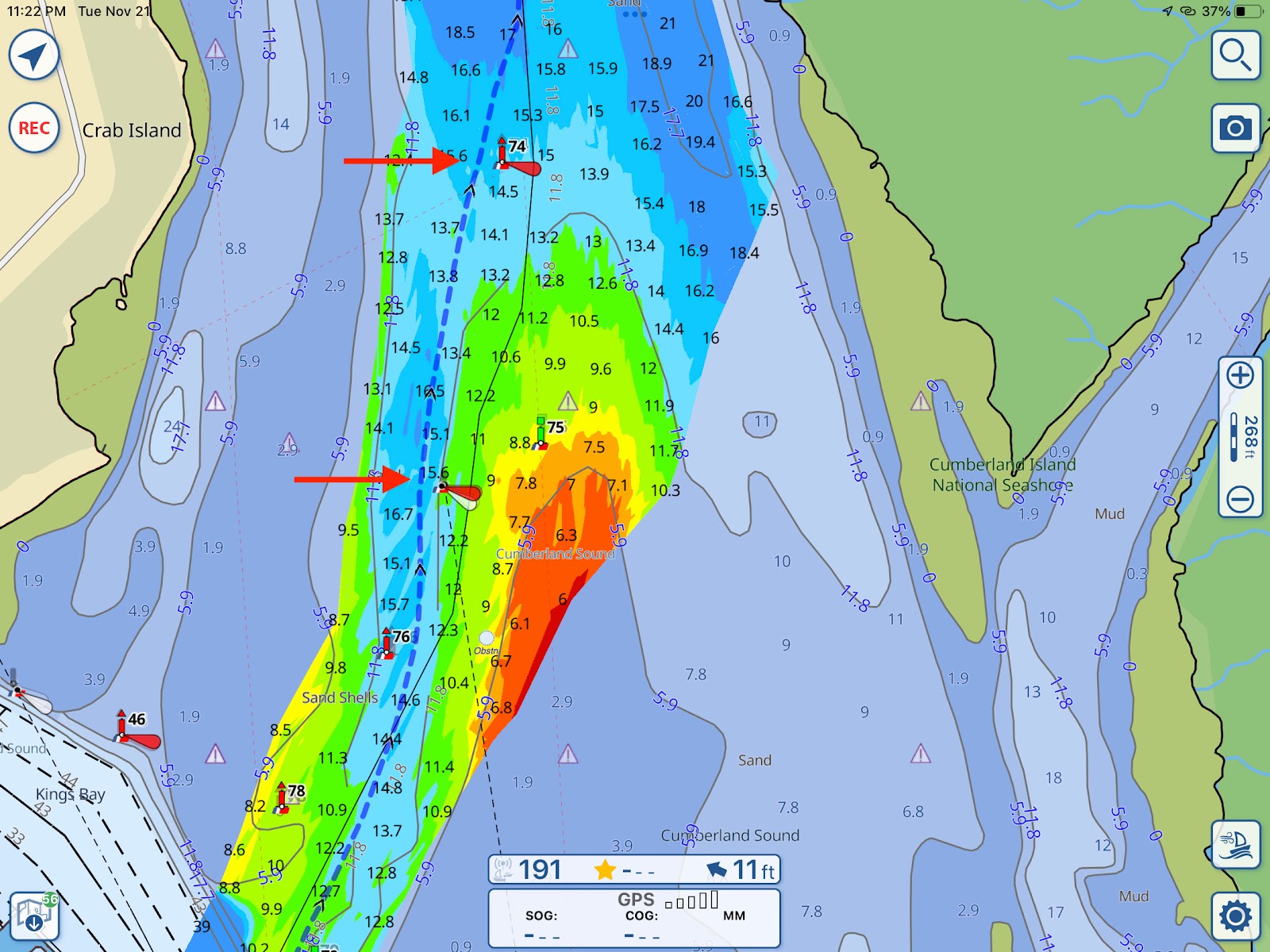
Well, today I watched two sailboats coming down the ICW approaching the Kings Bay Naval Base in southern Georgia. That's the base where they keep nuclear submarines, in case you didn't know. The naval patrol boats that guard the base are extremely watchful, and if you come anywhere near the base - as in within 500 feet, they come out to greet you with a sailor standing on the bow manning a deck mounted 50 calibre machine gun. They are not kidding around. When a sub is moving out, all traffic on Cumberland Sound is stopped by the USCG. You're ordered to move to the far side of the channel and if you refuse, as one sport fisherman did years ago, you're pulled over and taken off your boat in handcuffs. 
I was holding my position, waiting for two boaters from my Sail to the Sun ICW Rally to catch up. One had been having fuel problems and was moving very slowly with another of the group covering him. The two zombies were ahead of my two. At one point, the zombies moved out of the channel, leaving two red channel marks to port to avoid a shoal, as noted by the red arrows.
What could go wrong?
These boaters didn't know they were moving into a restricted area. But, they would not have been in that restricted area had they not been following Bob's Tracks. And fortunately, the patrol boat was at the far end of his patrol area when this happened.
Notice, there IS a shoal there, but by staying to center channel, as noted by the green and red markers, you're going to be in over 12 feet of water at MLW. We were an hour off high tide. I was sitting just outside the channel in 18 - 22 feet of water.
So I hailed the zombies as a courtesy to let them know they were out of the channel. One of them called back, Zombie-like, and said, I kid you not: "There's a shoal there and I'm the captain of my own boat." Well, I guess he told me, didn't he?
My response isn't worth repeating verbatim here, but it did involve telling this boater that a captain would have used his intelligence and stayed in the channel since it presented no hazards.
What hazards? You can generally be sure that the marked channel contains no hidden hazards, no sunken boats or debris from a hurricane that hasn't been removed. Outside of the channel, you have no guarantees. I have hit underwater debris when moving outside of a channel, fortunately not doing any damage. I've seen boats damaged in this way. My point is, that garbage is there and presents a hazard. Why push your luck by venturing outside of a marked channel when you don't have to?
Part of this attitude about honouring navigational marks comes from learning to sail, and then becoming a charter captain, in Lake Huron's Georgian Bay and North Channel. In those waters, the bottom is not mud, it's granite, as in "rock hard granite". Make a mistake there and you sink your boat, so I tend to honour navigational marks with a religious fervour. 
The 423 Zombies, and I've seen this in person, follow their leader's tracks exactly. Given that the actual serious problem areas on the ICW number less than a dozen, and then only at low tide, with a very small bit of planning, that's not necessary. You can get by simply by approaching these problem areas at mid to high tide.
That's what I do. Rather than risk a grounding, I plan my approach to places like Little Mud River, Jekyll Harbor, Brown's Inlet and others so that I pass through with lots of extra water under my keel. That gives me a margin for error just in case I fail to pay close enough attention and drift off the deepest water.
An example will be useful here. The Sail to the Sun ICW Rally went through Little Mud River two days ago. Little Mud shoals to about 4 feet at MLW, making it impassable for most boaters.
The day previous to getting there, we ended our day five miles and an hour early, anchoring in Crescent River beside Creighton Island. Got the afternoon off to relax, soak up some sun, do some reading.
We started the next day a bit later than usual, so on arriving at Little Mud River 90 minutes after low tide, we had 2.5 feet of extra water underneath us and a rising tide. Our deepest draft vessel was five feet, leaving a good margin of safety. 
This tactic also brought us to Jekyll Creek, another challenging area, later that same day at just after high tide, with 8 feet of extra water to safely get to the marina.
Planning is the key to comfortably and safely transiting the ICW, or any body of water. Take all the factors into consideration, and then time your passages to avoid problems, even if it means knocking off early the day previous. Running into the sunset until you can barely see before stopping is for delivery captains who know what they're doing, and fools who think they know.
I've been a delivery captain and run late when I had to, but I ain't no fool. And yes, I do take a look at Bob's Tracks, just as I check the online NOAA charts and other information in difficult areas to be sure I've not missed anything. I just don't follow the tracks religiously. They simply aren't that vital for all but the aforementioned problem areas on the ICW, and then, largely for newbies to the ICW.
Here's another thing I've noticed, and I'm quite surprised to see it.
My B&G chartplotter is in for repairs, so I've been using AquaMaps (without the tracks downloaded) in its place. I usually only use AquaMaps for planning purposes, as I like a properly designed chartplotter at the helm.
Why you ask? A tablet or phone will shut itself off if it gets overheated in the sun and won't restart until it has cooled down. 
Imagine that happening while you're in the middle of navigating through a difficult area - suddenly, no charts! I've had my phone shut down while using it at the helm for music, leaving me having to sing to entertain myself. If you've heard me sing, you know that's not a good thing!
Anyhow, AquaMaps is quite the nice program, and I'm impressed with its features, including the ability to download hydrographic charts of the bottom so that you can be aware of shoaling and make plans for it. 
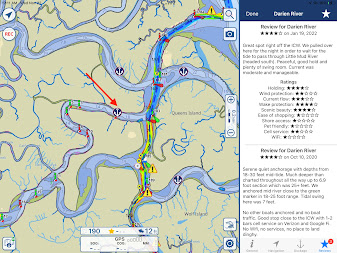
Another feature are the Waterway Guide anchorages that can be downloaded to the charts, allowing you to find a decent anchorage at the end of the day. But - and this is a problem - I've noticed that several of the anchorages shown are in marked channels. If you've been boating for any length of time, you know you aren't supposed to anchor in a marked channel, such as the one in this photo shown by the arrow.

What these "reviewers", whose names I've redacted, seem to be unaware of is that at the end of this river is a fleet of shrimpers out of Darien, GA, who use this river regularly, day and night. And clearly, whoever chose to put this anchorage up isn't paying attention to the details either.
This is not a proper anchorage, it's a marked channel in which anchoring is not permitted.
And it's not the only one marked like this, so be aware.

Do I use Bob's Tracks? As I admitted above, yes, I do. I review them as I do all the available information in order to plan my day's passage, because smart boaters use every little piece of information they can get. I just don't get all Zombie like over them, and neither should you, and I don't refer to them at the helm because my planning doesn't require that.
If you don't know or haven't learned how to navigate, contact your local Power Squadron, Coast Guard or sailing schoool and learn how. It's not all that difficult, and it gives you an incredible burst of confidence to know that, should your chartplotter ever fail while underway (it's happened three times to me!), you're fully capable of finding your way to your destination safely without it.

(Full disclosure - I was a cruising editor for over ten years for Waterway Guides. I have never been a zombie and the only dead flesh I eat is a medium rare strip loin!)


Sunday, June 11, 2023

Engine Install Update...Day One.

Here's what's happening.... I picked up a low hours 3GMF from a friend in the Keys, complete with transmission. It also comes with a Balmar alternator and smart regulator worth nearly what I paid for the engine.
The engine's mounts are in good shape, so that's $500 I won't need to spend.
An instrument panel came with the engine, but not the proper wire harness, so I'm looking for that - the same harness is used on these engines: 2GM, 3GM, 3GM30, 3GM30F, 3GMF, 4JH2-DTE, 4JH2-E, 4JH2-HTE, 4JH2-TE, 4JH3DTE, 4JH3-HTE, 4JH3-TE, 4JH-DTE, 4JH-E, 4JH-HTE, 4JH-TE, 4LH-DTE, 4LH-HTE,4LH-STE,4LH-TE. If you have one, please get in touch with me, thanks! 
This is a fresh water cooled engine - the old 2QM20 was a raw water engine, so hooking it up will be a little different, but not a lot as the inlet is in the same position on both engines. Same with the exhaust.
I will change impeller, oil filter and thermostat before putting the engine in the boat, since it's much easier done on a bench. Fresh oil in the engine and transmission. The antifreeze is clean and doesn't need replacement. The oil filter looks new, but for $8.72, what the heck. Live large!
Yesterday, I started on removing the old 2QM. The toughest part was getting started as I don't really like greasy, dirty work - note the look on my face
Two of the four engine mount bolts came off with minimal issues. The third is proving to be a problem - I needed a second 15/16th wrench or a 15/16 socket and a swivel. I'll be on the hunt for those shortly. The fourth mounting nut came off today as easily as the others. And naturally, it's that third one that's hardest to get at.
What's left after all this is unhooking the throttle and shift cables, water and exhaust hoses, and the electrical connections. All easy stuff and all done except for the alternator and the shaft coupling, which I've loosened but not fully removed yet. (Note to self: take lots of photos so you know what goes where later.)
The old mounting system I built 20 years ago will come out to be replaced by a new one. I made a few mistakes with the old one that I now have a chance to correct, simplifying engine alignment.
Next, remove the old engine, clean out the engine bay, install new soundproofing, tidy up wiring and remove old wires that aren't needed. 
I'm looking forward to the install, since it won't be all grease and dirt, the engine space will be clean, the bolts will be fresh and new, not rusted - and coated liberally with anti seize against future work. Being a smaller engine, the new one won't be as difficult to work with for tightening up bolts and attaching cables, etc. All in all, other than cleaning up, the worst is over with. I hope!
I'll share photos of Yanni once I get him out of the boat. If anyone is interested, I'll send him to a new home for you to rebuild. He comes with a nearly new alternator and starter, stainless steel exhaust elbow, new oil filter and fresh oil, new alternator belt, new impeller and if you want new mounts, I've got brand new aftermarket mounts as well at a wholesale price. I can also include a spare starter and an 80 amp alternator that I've got in storage. 
Now, back at it. Enough playing around!

Saturday, June 3, 2023

Announcing the Passing of Yanni the Yanmar...

Hi everyone - it's been a couple of years since I blogged here, and sometimes, as any writer will tell you, you need to break away, get a fresh vision, and that's something I've been working on.
Now that I've got that, I've been looking for a good place, a suitable "event", to start writing this blog again. This current event ought to get us off and running!   

~~~~~~~~~~~~~~~~~~~~~~~~~~~~~

All good things must come to an end... now before anyone panics, I'm not buying a trawler! Relax, let me tell you what's going on.

My unstoppable, tough little Yanmar 2QM20 that has been powering me between four countries and over 40 trips on the ICW, has passed on. Bit the dust, made its last passage, thumped its last thump. History, done for, fini. After well over 50,000 miles, it has sipped its last ounce of diesel.

And of course, it failed in the worst possible location, halfway between Beaufort SC and Charleston SC - with NO marina for miles. Heck, there was no human life for miles.
Fortunately, there was a cell signal, so I call my insurance company to send out a towboat. Because of the distance to the nearest marina, they asked me to sail further north to meet the towboat .... leaving me to explain the realities of sailing on the ICW on a completely wind-less day.
Let me check with management about that, Anna (the gal on the phone with me) says. Ten minutes later, it's organized.
The problem now is to find a marina. Every Charleston marina is full up, and even if they weren't, they won't accept a boat arriving under tow.
At this point, I actually thought my problem was with the starter. I didn't realize until yesterday that the engine had seized up. So I explained to the dockmaster at Bohicket Marina, about 14 miles away, that I would only be there for one to two days depending on how fast the new starter arrived.
"Nope", says he, not a chance. So - although I've actually been to Bohicket Marina before and it's nice, they are off my list of recommended stops because they showed no courtesy to a boater in need.
Another marina, one who was more polite about things, suggested checking with Ross Marine (https://www.rossmarine.com/), a boatyard a few miles to the south of Charleston, and that's where we went, to my great good fortune. It's a boatyard, and they've just decided to accept DIY boaters at their facility. More about this later, but if you need to know now, contact them and ask for Tom.
So the lovely lady at the other end of the phone at DB Electrical, who I admit I sweet-talked something awful, got my starter to me the next day, despite taking the order at 4:30. Astounding service!
I installed the starter, and got the same problem - CLUNK-click - but no "whirrrr" and then the sound of the diesel firing up. Clearly, something else was wrong.... I went below, cleaned up the grounds and connections, hit the button - CLUNK-click again.
Went below, had a wild thought, pushed the decompression levers down and tried to spin the engine, which should have been easily done by hand.
Nothing. Wouldn't budge. That meant my problem was much worse than I had thought. That clanking noise I heard when the engine shut down was not the starter self destructing at all. I wasn't leaving this place in the immediate future, at least, not in Gypsy Wind.
So, to fast forward to now, I've put out feelers for a new engine and have several good possibilities turn up in the last 24 hours.
I plan to remove this engine over the next few days while I decide on the new one, clean up the engine bay, tidy up wires and plumbing, install new soundproofing, redo the engine mounts to correct mistakes I made on the original installation and then fit in the new engine.
Shouldn't take more than a few hours, maybe a day? Sure, that sounds good.
So stay tuned here, I'll keep everyone up to date on this latest adventure.
In the meantime, one of the engines I came across, which won't work for me because I want to go to a more modern, lighter and smaller engine, belon
gs to Kimberly House, in central Florida.
It's a Yanmar 2QM20 and it's too big for her boat's engine space. She needs to sell this engine before she can get a different one, so if you can help her out here, please do so.
I will say this for the 2QM20 - they are a fabulous engine and as long as you're ok with the size and weight of it compared to a more modern engine, they will go virtually forever. Mine has easily over 15,000 hours on it and has only ever needed to have a fuel line repaired in 16 years.
That's because they were originally built as a tractor and industrial engine, so they were built to be bulletproof. Someone will buy my old engine to rebuild it and likely get another 15k hours of adventuring out of it.
There's a part of me that says, yes, just put in another one, and that's tempting because it would be so easy to do it that way. But getting more space in the engine room and losing about 100 pounds from the back of the boat is a strong incentive to switch. Besides, as anyone who knows me will tell you, I never do things the easy way! That would be, well... too easy!
Stay tuned to this space for updates on the new Yanni  Jr. installation. And someone please buy Kim's engine from her! Contact me via email or messenger for details.

Wednesday, April 21, 2021

Boating Organizations are Failing Us

Earlier this week, I sent a letter to the leaders of the boating organizations and businesses that are supposedly representing us in Florida with regards to the anchoring legislation. I have not heard back from them about the concerns I brought up. 

Those organizations include the Seven Seas Cruising Association, the Marine Trawler Owners Association, the American Great Loop Cruising Association, Boat US and Waterway Guide.
Why should this concern you? 

It's because I wrote to them about significant issues in the anchoring bills currently in front of Florida’s legislation, including two major issues I have not yet brought up in public until now.  (Portions of that letter are excerpted in this blog post.)
These boating groups that you support financially are failing to represent your interests by not fighting to stop HB 1515 and S 1946, which are the Anchoring Limitation Area bills. 

One of the leaders in this group has told me that they don't like these bills, but that they are the best we can get so they are going along with them. That's a winning strategy if I've ever heard one.

These bills as written will keep you from being able to anchor for more than 30 days out of six months in designated areas, areas determined by local governments. And you can 'bet your bippy' that those will be areas that are ones boaters have found to be both safe and convenient.

So why are these groups not fighting these bills? It’s because they think, wrongly imo, that these bills won’t affect cruisers. And as I said, it's because they don't believe that they can stop the legislature from enacting them. 

That attitude is exactly how we got FL § 327.4108 and lost the right to anchor in Sunset Lake, Miami Beach, and Middle River, Fort Lauderdale in 2016/17.
 
Fine, you say!
I never anchor more than a couple of weeks in any one place anyhow. 
Great! And what happens when that one month in six gets reduced to two weeks, or one week, or 72 hours? That's what will happen as local jurisdictions start using the new laws. They'll ask for more and more restrictions on boaters until all our rights to anchor are gone, until we return to the mess that we had prior to 2007.

Can't happen? 
Uh, yes, it can. Why do you think we had Florida § 327.60? It was to prevent the patchwork of different local laws that we had prior to 2007 where places like Melbourne and Fort Lauderdale had 72 hour anchoring limitations. 

We were promised by the legislature that local authorities would not be permitted to enact local ordinances - and now we're right back to that.
Regardless of anything else, that simply isn't right. But there's worse, much worse, in these bills. Be afraid.

There are serious problems with this legislation

HB1515 has some huge problems associated with it. For starters, the FWC who will be tasked with implementing and enforcing it are concerned. More than one senior staff at the FWC has told me quietly that they do not have the resources - fiscal or personnel - to take on the requirements of HB 1515. 

They were unable to complete the survey required of them in HB 1221 (2019) and now the legislature is considering adding even more to their workload? How will that work out?

The FWC does not want, and cannot handle, the extra responsibilities mandated by the bill. They will be in favor of any effort put forth by the boating associations put forth to kill it.

Secondly, and again this is from the FWC, there is no data available, no survey, for any county in Florida on the extent of the “navigable waters” of the state. That being the case, there is no valid or legal way they can permit 10% ALAs because they simply don’t have the data to determine just how big 10% actually is.

Yes, some county can say that their proposed area is clearly less than 10% and yes, they could clearly be correct about it, but without the data showing what the facts are, those claims cannot stand. Florida doesn’t even have a legal definition of “navigable waters”, although they are trying to create one in the legislation. But, this lack of data is too big a weakness to be papered over.

Anything that any county does to create an ALA will be subject to a legal challenge demanding that the county present proper studies justifying their request, including a legal definition of what constitutes “navigable waters” - a state issue. If the bill does pass, it will be years before any community can get an ALA, provided that there is an entity willing to sue. And I assure you of this, there will be one, the Cruisers Rights Network of North America. 

Gulfport found that out the hard way last spring. We won’t back down.

Local governments will not want to spend the money on dealing with these lawsuits, or with doing the requisite surveys to authorize their ALAs, and the FWC has neither the funds nor resources to deal with doing the surveys.

These weaknesses are exploitable - provided these organizations wish to exploit them to defeat this bill. And so far, they have not.

But there is still far worse here: a Constitutional Violation of your rights

HB1515 states the following: 

(b)1. For a vessel in an anchoring limitation area under subsection (2), upon an inquiry by a law enforcement officer or agency, a vessel owner or operator must be given an opportunity to provide proof that the vessel has not exceeded the limitations described in subsection (2). 

Such proof may include any of the following: 

a. Documentation showing that the vessel was in another location at least 1 mile away within a period of less than 30 days before the inquiry. 

b. Electronic evidence, including, but not limited to, navigational devices or tracking devices that show the vessel was in another location at least 1 mile away within a period of less than 30 days before the inquiry.

2. If a vessel owner or operator fails or refuses to provide proof that the vessel has not exceeded the limitations described in subsection (2), the law enforcement officer or agency may issue a citation for a violation of this section.

Two lawyers and an out of state legislator have said to me that in their opinions this section violates the federal Constitution’s concept of "presumption of innocence”. For our purposes here, the definition of “presumption of innocence” from an online legal dictionary is useful, and is essentially the same regardless of which source you choose:

“Presumption of innocence: A principle that requires the government to prove the guilt of a criminal defendant and relieves the defendant of any burden to prove his or her innocence.”

Is there any reason that this has not been brought up to the various committees examining this bill? Isn’t this something vital that our associations would want to address?  

What the law currently requires of a person charged under HB 1515 is that they go to court to prove their innocence, if they could not do so when offered the opportunity by the LEO at the time of writing the citation. And that, to any thinking human being, is the exact opposite of “presumed innocent”. 

Now, would you like to know why this bill is written in this manner? It’s because it is absolutely impossible to get a conviction without having monitored the boat in question for the entire thirty days. 

All the individual charged has to ask the officer in court is the following: 


“Sir/Ma’am, did you observe this boat continuously for the past thirty days?”
You did not? Then please, Sir/Ma’am, provide this court with proof that the boat in question did not leave the ALA for thirty days.”


END OF STORY right there. It is the prosecution’s legal obligation to provide proof of guilt. It is NOT the accused’s obligation to prove he left the ALA before the 30 days was up. There can be no conviction and NO way of forcing anyone to move their boat without significant legal issues arising to the prejudice of the acting authority.

Let us consider this point: shouldn't this very important issue be brought up with the boating group members? This one thing alone will kill HB 1515 at this late date. It's central to the entire bill. 

I won’t even get into how the way this bill is to be enforced is basically an intimidation tactic, one that will force boaters to leave rather than fight for what is theirs: the right to remain legally anchored.


Oh, What the Heck, Let’s Go There.

So, you tell me, if the boater is over thirty days in one place… they need to move on. They won't be harassed if they’ve not been anchored there that long.

Sorry, here’s what will really happen, because I’ve seen it happen way too often, including to myself back before 2007 when I was in Fort Lauderdale’s 72 hour anchoring bylaw area. 

The law rolls up in his/her police boat and demands you prove you haven't been there for 30 days. For whatever reason, you cannot prove this and you are forced to move, or you get a citation to appear in court. Most boaters of course will simply move on, they don't want the fight. That's what I did in Fort Lauderdale.

Can't happen, won't happen, you say? 

Sorry, but it will. Here’s what I’ve personally observed in the past. 

In 2007, an assistant city attorney in Melbourne blatantly told me that she would charge boaters under their local 72 hour ordinance, regardless of the terms of Florida Statute 327.60, and let the accused appear in court to prove her wrong. I stopped that from happening and forced Melbourne to stop enforcing their local ordinance.

In 2016, Miami Beach attempted to enforce their illegal anchoring bylaw. Working with a local boater, Dr. Tenzer, a group of us put a stop to that. Tenzer got a financial settlement from the City for his legal costs.

In the spring of 2020, the Chief of Police in Gulfport FL lied outright about the issue of their illegal enforcement of 327.60. As you all know, the CRNNA stopped the enforcement of their illegal ordinance.

Just a few weeks ago, the City Attorney in St. Petersburg tried to BS me about whether their police were attempting to enforce their local, illegal anchoring ordinance, which they were doing. We ended that practice there also.

If you believe this can't happen, you're mistaken. As I’ve just demonstrated, it can, it has and it will again. 

It’s happening now in fact. Some of you have told me of several jurisdictions that are using illegal ordinances to intimidate boaters and move them on. The CRNNA can’t deal with these communities yet as we don’t have the evidence we need to stop them. And for the record, we do this work quietly, respectfully and seeking to gain the co-operation of the local authorities in eliminating enforcement of these illegal ordinances. We’ve been successful in every case, although St. Petersburg did require a second warning before they got the message.

Bottom line here as we know is that local authority listens to their local taxpayers, not the individual boater, and really, what would you do as the boater in this situation? Take the ticket and go to court, or move on? We all know the answer to that one, don’t we?

HB 1515 will affect every cruiser traveling in Florida who chooses to anchor. This kind of behaviour from local law enforcement was the case pre-2007, it’s been the case all along, and it will be the case going forward, but it will be far worse without the protection of 327.60. 

So What Can I Do?

First of all, if you're a member of one of the above organizations, contact your executive and ask them why they aren't acting on these issues. 

Here's what you'll get back from them.

They'll tell you I don't know what I'm talking about, or I'm wrong, or I'm an idiot and you should just ignore me. 

Please tell them, from me, that if they believe any of that then they should explain why, to me, instead of ignoring what I've said, so I can give you the correct information. Tell them also that they were wrong in 2016/17 and they are making the same mistake now - trusting the legislators to not go back on their word.  

Secondly, demand that they address these issues before we lose our rights to still more anchorages in Florida. They were, all of them, wrong in 2016 and 2017 and they are doing the same thing now. These groups are your groups if you pay dues and they are supposed to do what you want.

Third, and this applies to everyone, you need to right now contact the members of the Florida legislature about these issues and kick up a fuss. Send emails and even more importantly, phone them. Make it clear to their staff, since you likely won't reach the member, that you are concerned about the significant problems these bills have.

Next, contact your boating and local media, particularly if you live in Florida. Explain to them why you are concerned. 

Finally, share this blog post with everyone you can. More than just boaters need to be concerned when the error in the bill is a violation of your Constitutional rights.

You can follow this issue on the CRNNA's Facebook page for up to date information.

We have only a few days to stop this from happening.
 

If you don't take action immediately, you can expect these bills to pass. I promise you that if we don't act now, within three to five years, there will be huge areas in Florida where you will not be able to anchor overnight, if at all. 

I wish I was wrong - but I'm also wishing I'd spoken up in 2016 when the original mistakes that lead us to this point were made by our boating organizations.

The people running our boating groups think they are right, they think they are doing the proper thing here. Bless them, their hearts are in the right place, but they are not doing what needs to be done and that has to change.

It's time to get angry and speak out. Today. Right now. We don't have any time left. If you're a  boater and don't want to lose your right to anchor in Florida, act now.